
By Marcus Vance, Testing Director | JuicerPress Appliance Lab
Direct Answer: How Does JuicerPress Test Juicers and Blenders?
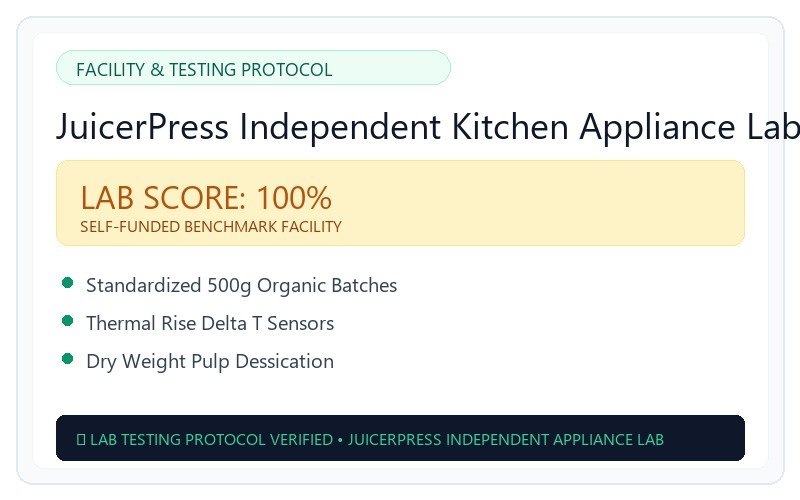
JuicerPress tests juicers and blenders using a repeatable 6-step laboratory protocol that quantifies liquid extraction yield, pulp moisture retention, thermal rise (ΔT), decibel noise levels, teardown cleanup time, and particulate micro-texture. Rather than subjective impressions, every appliance is challenged with standardized 500g batches of fibrous organic celery, dense carrots, and curly kale using calibrated tare scales, dual-laser infrared thermometers, and digital sound level meters.
The 6 Pillars of Our Testing Protocol
flowchart TD
    P1["1. Standardized Produce Calibration (500g Tare)"] --> P2["2. Liquid Yield & Extraction Rate (%)"]
    P2 --> P3["3. Mechanical Pulp Moisture Press (2kg / 60s)"]
    P3 --> P4["4. Thermal Rise Delta (ΔT IR Laser)"]
    P4 --> P5["5. Acoustic Noise Pressure (dB at 1m)"]
    P5 --> P6["6. Breakdown & Sanitation Teardown Clock"]
Step 1: Standardized Produce Sourcing & Temperature Calibration
Variations in produce moisture can skew test results. To ensure absolute parity:
- We source certified organic Pascal celery, Granny Smith apples, and curly kale from the same regional distributor.
- All produce is stored in a commercial refrigeration unit at 38°F (3.3°C) for a minimum of 12 hours before testing.
- Each test sample is weighed on a calibrated A&D digital laboratory scale to exactly 500g (+/- 1g).
Step 2: Quantitative Extraction Yield (Liquid Volume & Weight)
Produce is fed into the machine according to manufacturer guidelines without artificial plunger force.
- Extracted liquid is collected in a calibrated tare vessel and filtered through a 100-mesh culinary strainer to separate true liquid volume from suspended floating pulp.
- Yield is logged in both net milliliters (ml) and percentage extraction rate:
$$text{Extraction Rate (%)} = left(frac{text{Net Juice Weight (g)}}{500text{g Produce}}right) times 100$$
- A top-tier masticating juicer achieves 82% to 86% celery yield; low-efficiency centrifugal units typically range between 58% and 65%.
Step 3: Pulp Moisture Retention (The 2kg Mechanical Press Test)
The true mark of a quality auger is the dryness of the discharged waste.
- The ejected pulp is gathered immediately and placed inside unbleached industrial filter paper.
- A calibrated 2kg pneumatic press exerts uniform compressive force for exactly 60 seconds.
- The residual moisture expelled onto the absorbent pad is weighed to determine the Pulp Wetness Index. Dry, powdery pulp indicates maximum cellular rupture.
Step 4: Thermal Rise Measurement (ΔT)
Heat accelerates oxidation and denatures heat-sensitive enzymes like bromelain and polyphenol oxidase.
- We record the surface temperature of the produce prior to entering the feeding chute using a dual-laser infrared pyrometer.
- A second laser reading captures the juice stream exiting the collection spout.
- The Benchmark: Premium cold press units exhibit a thermal rise under +1.2°F (+0.7°C). Fast centrifugal discs spinning at 14,000 RPM frequently elevate juice temperatures by +6.5°F to +9.5°F.
Step 5: Acoustic Sound Pressure Calibration (Decibel Meter at 1m)
Kitchen noise matters, particularly for early morning juicing in shared households or apartments.
- A digital Sound Level Meter (Type 2, A-weighted, slow response) is positioned at ear height exactly 1 meter from the appliance.
- Baseline ambient lab noise is maintained below 35 dB.
- Maximum peak decibels (dB) and continuous running averages are recorded across hard carrot and root vegetable trials.
Step 6: Teardown, Brushing & Sanitation Clock
An appliance that takes 15 minutes to scrub will inevitably end up abandoned in a kitchen cabinet.
- Our technician disassembles the unit immediately after extraction.
- We clock the exact minutes and seconds required to rinse the drum, brush the micro-mesh screen under running tap water, clean the pulp chute with the reverse hook, and place all components in a drying rack.
Blender-Specific Benchmarks: The Silkiness Sieve Test
For high-performance blenders (Vitamix, Ninja, NutriBullet), we evaluate micro-texture:
- We blend 50g raw kale, 1 cup frozen mango chunks, 1 tbsp chia seeds, and 1 cup cold coconut water for 60 seconds.
- The mixture is poured through a standard 30-mesh stainless-steel culinary sieve.
- Unpulverized leafy fragments and seed grit are dried and weighed to calculate the Smoothie Silkiness Ratio (0 to 10).
Equipment Calibrations & Verification
All laboratory equipment is inspected and zero-calibrated monthly:
- Digital Scales: Ohaus Defender 3000 Series (Certified NIST traceable).
- Infrared Thermometers: FLIR Dual-Laser Pyrometer (+/- 0.5°F accuracy).
- Decibel Meters: Reed Instruments R8050 Sound Level Meter.
Questions regarding our testing protocols or suggestions for upcoming appliance trials can be directed to Marcus Vance at `lab@juicerpress.com`.