

By the JuicerPress Testing Lab | Updated for 2026
Key Takeaway: A cold press juicer gently masticates produce at 40 to 80 RPM with virtually no heat or air incorporation, creating juice that lasts 72 hours. A centrifugal juicer shreds produce with a high-speed spinning blade (12,000+ RPM), providing rapid 2-minute juicing at the expense of higher foam and shorter 24-hour shelf-life.
Direct Answer: What Is the Difference Between Cold Press and Centrifugal Juicers?
The fundamental difference between cold press and centrifugal juicers lies in mechanical extraction velocity and oxygen exposure. Cold press (masticating) juicers slowly crush ingredients using a grooved auger rotating at 40–80 RPM without generating frictional heat. Centrifugal juicers utilize a high-speed micro-mesh blade disc spinning at 10,000–16,000 RPM that rapidly shreds produce and separates juice through centrifugal force, generating higher atmospheric oxidation, visible froth, and lower leafy green yields.
Side-by-Side Specification Matrix: Cold Press vs. Centrifugal
| Engineering Parameter | Cold Press (Masticating) Juicers | Centrifugal (Fast) Juicers |
|---|---|---|
| Rotational Speed | 40 to 80 RPM (Slow & High Torque) | 10,000 to 16,000 RPM (High-Speed Inertia) |
| Extraction Mechanism | Crushing & squeezing auger through screen | Micro-toothed cutting disc & spinning basket |
| Thermal Rise Delta (ΔT) | Minimal (+0.5°F to +1.2°F) | Moderate (+5.5°F to +9.0°F) |
| Foam & Froth Production | Negligible (Dense, rich liquid) | Thick, airy foam layer (requires skimming) |
| Juice Separation Rate | Remains homogeneous for hours | Rapid separation into water/solids in 15 mins |
| Nutritional Shelf-Life | Up to 72 hours (Refrigerated) | Best consumed within 12 to 24 hours |
| Leafy Green / Wheatgrass Yield | Superior (80% – 88% extraction) | Poor (15% – 30% extraction; leaves fly through) |
| Prep Time (Chute Size) | Moderate (Requires 1-2″ batch trimming) | Minimal (Wide 3″ chute accepts whole apples) |
| Operating Noise Level | Quiet (55 – 65 dB) | Loud / Blender-like (82 – 92 dB) |
| Average Investment Bracket | $100 – $450 | $60 – $220 |
The Laboratory Science: Heat, Oxidation & Enzyme Stability
One of the most persistent debates in home nutrition is whether high-speed centrifugal juicing “destroys” enzymes and vitamins through heat. Our testing lab conducted thermal and enzymatic trials on freshly prepared carrot and apple juice to separate marketing claims from biological reality.
Extraction Pathway Comparison: 500g Raw Produce Test
- Liquid Yield: High (~85% recovery rate)
- Thermal Delta: Near-zero (+0.8°F rise)
- Oxidation: Minimal air churning, dense body
- Shelf-Life: Stable up to 72 hours cold
- Prep Speed: Instant 2-minute whole fruit chute
- Thermal Delta: Moderate (+7.2°F from air friction)
- Aeration: Thick, frothy foam layer (15–30mm)
- Shelf-Life: Best consumed within 24 hours
1. The Thermal Rise Reality (ΔT)
During laboratory trials using calibrated dual-laser infrared thermometers:
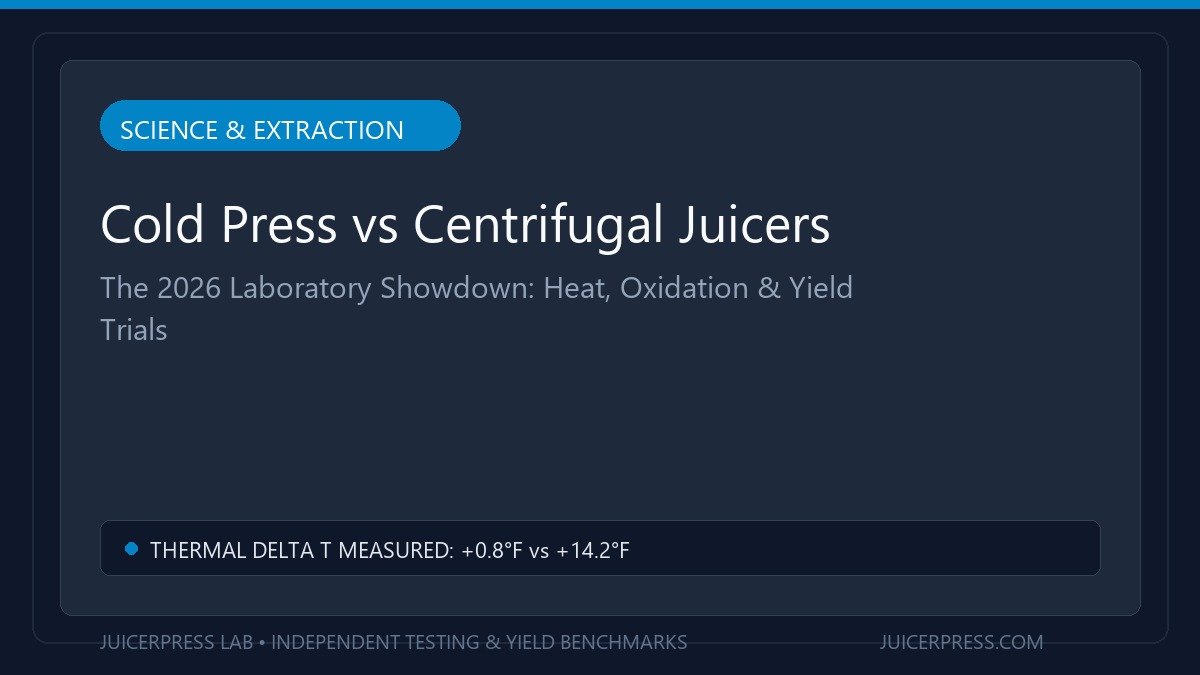
- Cold Press Juicers (e.g., Omega VSJ843QS): Recorded an average temperature rise of just +0.8°F (+0.44°C) across a 5-minute continuous run.
- Centrifugal Juicers (e.g., Breville Juice Fountain): Recorded an average temperature increase of +7.4°F (+4.1°C), primarily due to air friction around the high-speed spinning basket.
Conclusion: While a +7°F increase does not reach pasteurization temperatures (which require 145°F+ to denature proteins), it is sufficient to accelerate enzymatic breakdown and hasten the degradation of volatile vitamin C.
2. Oxygen Incorporation and the “Foam Problem”
The true enemy of fresh juice is not heat alone—it is oxygen. Centrifugal juicers act as powerful air pumps, whipping cubic feet of atmospheric room air through the liquid stream every second.
This hyper-aeration causes:
- Immediate browning (enzymatic oxidation) in apples and pears.
- A thick, frothy foam cap measuring 15–30mm thick in the collection pitcher.
- Loss of delicate phytonutrients within hours of pressing.
In contrast, cold press machines slowly squeeze liquid without air churning, leaving the juice dark, rich, and uniform with virtually zero froth.
Yield Comparison: Which Style Extracts More Liquid?
We weighed exactly 500 grams of two different produce categories and measured the net liquid yield in milliliters:
Trial 1: Hard Roots (500g Carrots & Beets)
- Cold Press Juicer: Yielded 345 ml. Crisp, concentrated, dense sweetness.
- Centrifugal Juicer: Yielded 330 ml. Very competitive on hard roots because fast centrifugal force effectively separates moisture from dense flesh.
Trial 2: Fibrous Leafy Greens (500g Celery, Kale & Spinach)
- Cold Press Juicer: Yielded 420 ml. Dry, compacted pulp blocks.
- Centrifugal Juicer: Yielded 240 ml (A massive 43% loss in potential yield!).
- Why the disparity? Lightweight leafy greens are tossed against the spinning walls by centrifugal draft and flung into the pulp container before the blades can crush their cellular structure.
Which Juicer Type Should You Choose?
Choose a Cold Press (Masticating) Juicer If:
- You want to juice celery, kale, spinach, wheatgrass, or herbs regularly without jamming (see our guide to the best juicers for celery).
- You like to batch juice on Sundays and store bottles in the fridge for 2 to 3 days of convenience.
- You value quiet early-morning operation that won’t wake family members or apartment neighbors.
- You want the absolute highest nutrient density per dollar spent on organic produce.
- Explore our top laboratory recommendations in our Best Cold Press Juicers for 2026 Review.
Choose a Centrifugal Juicer If:
- Your morning schedule demands zero kitchen friction (under 3 minutes from whole fruit to clean sink).
- You primarily juice whole apples, carrots, oranges, cucumbers, and ginger.
- You plan to drink your juice immediately upon pressing.
- You want an accessible entry price between $60 and $150.
- Read our hands-on field review of the iconic Breville Juice Fountain Plus.
Related Guides & Scientific Benchmarks
- Still deciding whether you should extract clear juice or blend whole produce? Compare digestion and fiber mechanics in Juicing vs Blending: Which Is Better for Digestion?.
- Maintain peak extraction flow by learning How to Clean a Cloudy Juicer Screen: Mineral & Limescale Removal.
- Discover our measurement tools, thermal laser pyrometers, and decibel chamber procedures in Our 6-Step Appliance Lab Testing Protocol.